
Google Maps (Local Pack) rankings are one of the highest-ROI marketing channels for local businesses. The top three spots can generate the majority of phone calls and website visits. Online reviews are one of the strongest ranking factors — and the good news is you can influence them directly.
Here’s a complete, up-to-date playbook on how to leverage reviews to dominate local search.
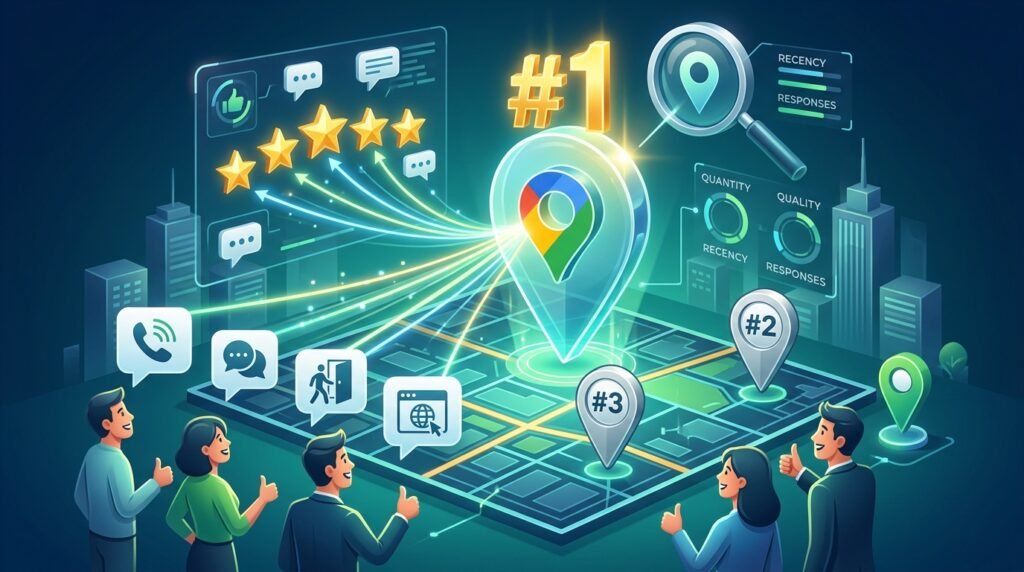
Why Reviews Matter for Google Maps Rankings
Google evaluates three core review signals when ranking local businesses:
- Quantity — More reviews signal popularity and trustworthiness.
- Quality & Relevance — Reviews that mention specific services, locations, or keywords help Google understand what you’re best at.
- Recency — Fresh reviews carry more weight than older ones.
Businesses that treat reviews as an ongoing ranking asset consistently outrank competitors with fewer or stale reviews.
Step-by-Step Strategy to Rank #1 on Google Maps
- Build Consistent Review Velocity
Aim for a steady flow rather than occasional spikes. Even 2–4 new reviews per week is often enough to climb the rankings. Set up automated review requests that trigger 24–48 hours after every service or sale. - Optimize Review Content for Keywords
Encourage customers to mention specific phrases naturally:- “Best coffee in downtown Austin”
- “Fast oil change near me”
- “Friendly pediatric dentist in [neighborhood]”
Train your team to gently suggest these topics when asking for reviews.
- Respond to Every Review Within 24–48 Hours
Google rewards active engagement. Public, personalized responses (even to 5-star reviews) improve both ranking signals and customer perception. Encourage customers to mention specific phrases naturally: - Fully Optimize Your Google Business Profile
- Add high-quality photos and videos regularly
- Post weekly updates and offers
- Complete every section (products, services, attributes, Q&A)
- Verify and claim all locations
A complete profile + strong reviews creates a powerful ranking combination.
- Monitor Competitor Review Activity
Use free or paid tools to track how many reviews your top competitors receive monthly. If they’re getting more, you need to increase your own volume or improve response quality. - Leverage Review Syndication
Some platforms automatically push reviews to Google, Facebook, and other sites. This increases total review count and visibility across the web. - Use Review Request Timing Strategically
The best times are right after a positive interaction:- Immediately after checkout
- 24 hours after service completion
- Same day for in-store purchases
Common Mistakes That Hurt Google Maps Rankings
- Ignoring negative reviews
- Requesting reviews too aggressively (can look spammy)
- Using generic “Please review us” messages
- Letting review profiles go stale
Quick Action Plan for the Next 30 Days
- Audit your current Google Business Profile completeness
- Set up automated SMS + email review requests
- Create 3–4 personalized review request templates
- Commit to responding to every review within 48 hours
- Track review volume and Local Pack position weekly
Final Takeaway
Ranking #1 on Google Maps is achievable for most local businesses when reviews are treated as a strategic asset rather than an afterthought. Focus on consistent volume, keyword-rich content, timely responses, and full profile optimization. The businesses that execute these tactics consistently will dominate local search in 2026 and beyond.